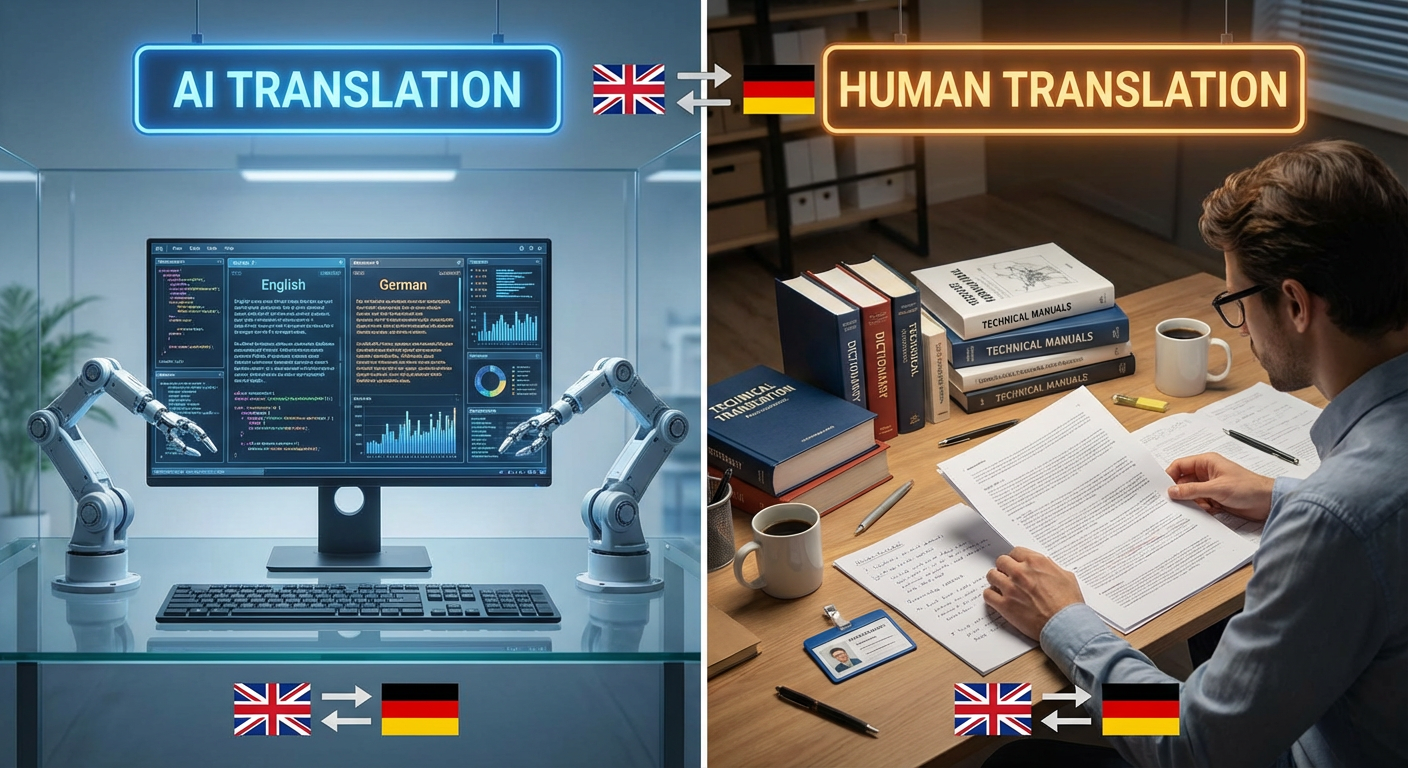
The English-German translation corridor represents one of the most economically significant language pairs in global business, connecting the world's lingua franca with Europe's largest economy. As artificial intelligence revolutionizes translation technology, a critical question emerges: can AI match or surpass human translators for technical content between English and German? The answer reveals a nuanced landscape where machines demonstrate impressive capabilities while humans retain irreplaceable advantages, pointing toward a future of sophisticated collaboration rather than simple replacement.
The English-German Technical Translation Challenge
Before examining AI versus human approaches, we must understand what makes English-German technical translation complex. While both are Germanic languages sharing common roots, they've diverged significantly, creating specific challenges for technical documentation.
Compound Words and Technical Precision
German's famous compound word construction creates terms like "Geschwindigkeitsbegrenzung" (speed limitation) or "Kraftfahrzeughaftpflichtversicherung" (motor vehicle liability insurance). Technical German generates even more complex compounds: "Wärmeausdehnungskoeffizient" (thermal expansion coefficient) or "Hochfrequenzleistungsverstärker" (high-frequency power amplifier).
These compounds pack substantial meaning into single words, requiring translators to understand not just the component parts but how they combine to express precise technical concepts. English typically expresses these concepts through multi-word phrases, requiring careful structural decisions during translation.
Word Order and Sentence Structure
German places verbs differently than English, particularly in subordinate clauses where verbs migrate to clause endings. Technical documentation—which relies heavily on complex sentences with multiple clauses—must be carefully restructured when translating between these languages. A technical specification readable in German might become incomprehensible if word order is simply swapped without proper restructuring.
Grammatical Gender and Case System
German maintains grammatical gender (masculine, feminine, neuter) and a four-case system (nominative, accusative, dative, genitive) that English has largely abandoned. Technical terminology requires correct gender assignment and case marking, affecting not just the terms themselves but accompanying articles, adjectives, and pronouns throughout sentences.
Technical Terminology Standardization
German technical terminology is highly standardized through organizations like DIN (Deutsches Institut für Normung). Translators must navigate not just linguistic accuracy but conformity to industry standards, particularly for regulated industries like automotive, engineering, or medical devices where non-standard terminology can create legal or safety issues.
AI Translation: Impressive Progress and Persistent Limitations
Modern AI translation, particularly neural machine translation, has achieved remarkable quality for English-German translation. Services like DeepL, Google Translate, and specialized engines demonstrate capabilities that would have seemed impossible a decade ago.
Where AI Excels
Speed and Volume: AI processes millions of words per hour, translating entire technical manuals in seconds. For organizations managing vast documentation sets, this speed advantage is transformative, enabling translation that would be economically impossible with purely human workflows.
Consistency in Simple Terminology: AI maintains perfect consistency for straightforward technical terms it encounters repeatedly. Once it translates "torque wrench" as "Drehmomentschlüssel," it will apply this translation identically throughout, avoiding the inconsistency that can occur when human translators work on lengthy documents.
Straightforward Technical Content: For simple, clearly written technical specifications or standard procedures, modern neural machine translation often produces acceptable results. Clear source text about well-documented technologies in common technical domains can be translated by AI with reasonable accuracy.
Cost Efficiency: AI translation costs a fraction of human translation, making it attractive for content where perfect quality isn't critical—internal documentation, draft translations, or content for comprehension rather than publication.
Where AI Struggles
Despite impressive capabilities, AI translation reveals consistent limitations when handling English-German technical content.
Compound Word Construction: AI often struggles with German compound word creation and decomposition. It might break single German compounds into awkward English phrases or incorrectly combine English terms into German compounds that don't follow proper construction rules. A machine might generate technically accurate but stylistically incorrect compounds that native German speakers would never use.
Context-Dependent Terminology: Technical terms often have different translations depending on specific context. "Lager" in German can mean bearing, warehouse, or stock depending on context. AI systems sometimes select contextually inappropriate translations despite neighboring words that should signal correct meaning to an experienced translator.
Complex Sentence Restructuring: While AI handles simple sentences well, complex technical sentences with multiple dependent clauses often emerge awkwardly translated. The AI might preserve grammatical correctness while producing sentences that native speakers find unnatural or difficult to follow. Technical clarity—essential in documentation—can suffer even when translation is technically correct.
Cultural and Industry Conventions: German technical writing follows specific conventions regarding formality, structure, and terminology that differ from English practices. AI typically produces translations that sound more English-influenced than authentically German, potentially affecting user reception and professional perception.
Ambiguity Resolution: Technical writing sometimes contains ambiguous pronouns or references that humans resolve through context and domain knowledge. AI systems frequently misresolve these ambiguities, producing translations that technical experts immediately recognize as incorrect.
Safety-Critical Content: For content where errors could cause safety issues—warnings, operating procedures for dangerous equipment, medical device instructions—AI's error rate, though low, remains problematic. A 99% accuracy rate means potential errors in every hundred segments, unacceptable when human safety is at stake.
Human Translation: Irreplaceable Expertise
Professional human translators bring capabilities that current AI cannot replicate, particularly for technical content demanding high quality and reliability.
Deep Contextual Understanding
Human translators understand not just words but meanings, intentions, and implications. They recognize when a term is used unconventionally, catch inconsistencies in source text, and adapt translations to maintain technical accuracy even when source content is ambiguous or poorly written.
Domain Expertise
Specialized technical translators possess subject matter knowledge that informs their translation decisions. A translator specializing in automotive engineering understands the systems being described, enabling them to recognize and correct source text errors, select appropriate specialized terminology, and ensure translations maintain technical accuracy.
Cultural Competence
Human translators navigate cultural differences in technical communication. They understand that German users expect different information hierarchy, formality levels, and explanation styles than English users, adapting translations accordingly. This cultural adaptation creates documentation that feels native rather than translated.
Quality Judgment
Experienced translators assess quality holistically, considering whether translations are not just accurate but clear, professional, and appropriate for their audience. They recognize when technically correct translations might confuse users and find alternative expressions that maintain accuracy while improving clarity.
Creative Problem-Solving
Technical texts sometimes contain wordplay, marketing language, or cultural references requiring creative adaptation rather than direct translation. Humans excel at these creative challenges, finding equivalent expressions that achieve similar effects in the target language.
The Hybrid Approach: Optimal Quality and Efficiency
The most sophisticated organizations recognize that AI versus human isn't a binary choice but a spectrum of collaboration opportunities. Different content types and quality requirements call for different approaches.
Post-Editing: AI Draft, Human Refinement
Post-editing workflows use AI to generate initial translations that human translators then review and correct. This approach can be 30-50% faster than translating from scratch while maintaining human quality standards. For English-German technical translation, post-editing works well when source text is clear, terminology is standardized, and content doesn't require extensive restructuring.
The key is matching post-editing effort to content importance. Light post-editing fixes obvious errors while accepting some imperfection—suitable for internal documentation. Full post-editing produces publication-quality translations—appropriate for customer-facing content.
Human Translation with AI Assistance
Rather than starting with AI output, this approach has human translators work with AI as an assistant. CAT tools integrate machine translation suggestions alongside translation memory matches, letting translators choose when AI suggestions are helpful and when fresh translation is needed. This preserves human control while leveraging AI for efficiency.
Tiered Service Models
Sophisticated translation providers offer tiered services matching approach to need:
- Machine Translation Only: Fast, cheap, for comprehension purposes
- Machine Translation + Light Post-Editing: Moderate cost and quality, for less critical content
- Machine Translation + Full Post-Editing: Higher quality, for important but straightforward content
- Human Translation: Premium quality, for complex, creative, or safety-critical content
Professional Tools and Workflows
Professional English-German technical translation, whether AI-assisted or purely human, relies on sophisticated tools that enhance quality and consistency.
SDL Trados and CAT Tools
Computer-assisted translation tools like SDL Trados remain central to professional workflows. These tools provide translation memories (databases of previously translated segments) and termbases (terminology management), ensuring consistency across projects while letting translators leverage previous work. Modern CAT tools integrate AI translation suggestions alongside human-created translation memories, enabling flexible hybrid workflows.
Making Translation Data Accessible
Professional translation tools store data in formats optimized for translation workflows but not necessarily for broader business use. Converting SDL files and translation memories into accessible formats enables broader organizational use.
Services like linigu.cloud bridge this gap by converting various SDL file formats into bilingual Excel or Word files. This conversion makes English-German translation data accessible to stakeholders who don't use specialized translation software—project managers reviewing content, subject matter experts verifying technical accuracy, or clients approving translations.
For English-German translation specifically, bilingual files enable efficient review processes. German native speakers can review translations alongside English source text, identifying issues even without translation expertise. Excel formats facilitate terminology extraction and analysis, helping organizations build and maintain comprehensive English-German glossaries over time.
Best Practices for Quality English-German Technical Translation
Whether using AI, human translation, or hybrid approaches, certain practices ensure optimal results.
Invest in Quality Source Text
Clear, well-written English source text translates better, whether by AI or humans. Ambiguous pronouns, unclear antecedents, and convoluted sentence structures cause problems for both. Organizations should invest in source content quality, potentially using technical writing standards or editing passes before translation.
Build Translation Memories and Termbases
Systematic use of translation memories and termbases compounds benefits over time. Each project contributes to institutional knowledge, improving both efficiency and consistency for future work. For English-German technical translation, comprehensive termbases ensure standardized terminology that meets industry norms and regulatory requirements.
Match Approach to Content
Not all content requires the same quality level. Internal technical notes might be fine with raw machine translation, while product specifications require human expertise. Strategic decisions about where to invest in human quality versus accepting AI output optimize cost-effectiveness without compromising essential quality.
Continuous Improvement
Monitor translation quality systematically, gathering feedback from end users and technical experts. Use this feedback to refine termbases, improve translation memories, and adjust workflows. Both AI systems and human translators improve with systematic quality feedback.
The Future: Sophisticated Collaboration
The future of English-German technical translation isn't AI replacing humans but increasingly sophisticated collaboration between AI capabilities and human expertise. AI will handle more routine translation while humans focus on complex, creative, and quality-critical work.
Emerging technologies like large language models show promise for better contextual understanding and more natural output, potentially narrowing the human-AI quality gap. However, the fundamental need for human judgment, domain expertise, and cultural competence in technical translation suggests that human expertise will remain essential for the foreseeable future.
The most successful organizations will be those that thoughtfully integrate AI and human capabilities, using each where it provides optimal value while maintaining quality standards appropriate to content importance and usage.
Conclusion
English-German technical translation stands at a fascinating crossroads where impressive AI capabilities meet irreplaceable human expertise. AI translation has achieved remarkable quality, offering speed, consistency, and cost advantages that make it valuable for many applications. Yet human translators retain crucial advantages in contextual understanding, domain expertise, cultural competence, and creative problem-solving that ensure their continued essential role.
The optimal approach isn't choosing between AI and human translation but thoughtfully combining both, matching translation method to content requirements while leveraging professional tools like SDL Trados to maintain consistency and efficiency. Services like linigu.cloud further enhance workflows by making translation data accessible beyond specialized tools, enabling broader organizational participation in quality assurance and knowledge management.
As AI technology continues advancing, the translation profession will continue evolving, but the fundamental need for human linguistic expertise in technical communication ensures that the future belongs not to AI or humans alone, but to their sophisticated collaboration in service of clear, accurate, and culturally appropriate communication between English and German technical communities.
Comments ()
No comments yet. Be the first to comment!