Blog Article Content
Slug
navigating-english-hindi-technical-translation-challenges-with-sdl-trados
Title
Navigating English-Hindi Technical Translation: Mastering Challenges with SDL Trados
Excerpt
Explore the intricate challenges of English-Hindi technical translation and discover how SDL Trados, translation memories, and termbases transform complexity into consistency. Learn professional strategies for bridging two distinct linguistic systems in technical documentation.
Meta Description
Master English-Hindi technical translation with SDL Trados. Discover how TMs and TBs solve linguistic challenges between English and Hindi effectively.
Meta Keywords
English to Hindi translation, Hindi to English translation, technical translation challenges, SDL Trados Hindi, translation memory Hindi, Devanagari script, Hindi terminology, bilingual file conversion, Hindi technical translation, CAT tools Hindi
Content
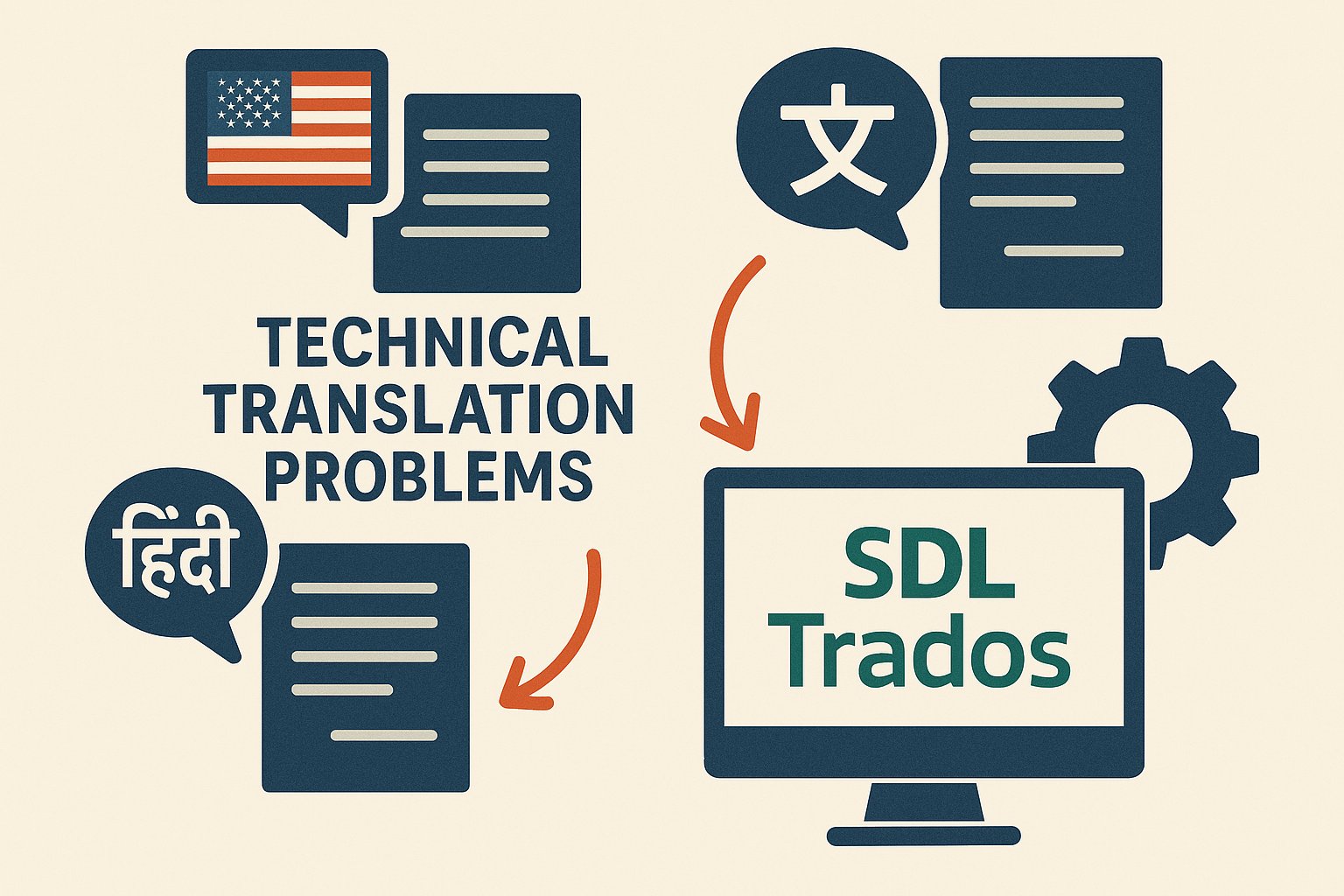
The linguistic bridge between English and Hindi connects over 1.5 billion people across two of the world's most widely spoken languages. As India continues its rapid technological advancement and global economic integration, the demand for high-quality English-Hindi technical translation has never been greater. Yet translating technical content between these languages presents unique challenges that go far beyond simple vocabulary substitution. From fundamentally different grammatical structures to distinct writing systems, from cultural context to technical terminology evolution, English-Hindi translation demands sophisticated tools and expert strategies. This is where SDL Trados Studio, combined with well-maintained translation memories and termbases, becomes not just helpful but essential for professional technical translators.
Understanding the Linguistic Landscape
Before exploring solutions, we must understand the challenges. English and Hindi, while both belonging to the Indo-European language family, have diverged significantly over millennia, creating obstacles at every linguistic level.
Script and Writing System Differences
The most immediately visible difference lies in writing systems. English uses the Latin alphabet with 26 letters representing sounds in a relatively straightforward manner. Hindi employs the Devanagari script (देवनागरी), an abugida writing system where consonant-vowel sequences are written as units. Each character carries inherent phonetic information, and vowel marks modify consonants to create different sounds.
This fundamental difference creates technical challenges for translation workflows. Devanagari requires proper Unicode encoding (specifically UTF-8), and display issues can corrupt characters if systems aren't configured correctly. Technical documents must preserve character integrity through multiple file format conversions—Word to PDF to InDesign and back—where a single encoding error can render text unreadable or introduce incorrect characters that alter meaning.
Grammatical and Structural Differences
English and Hindi organize information in fundamentally different ways. English follows a relatively strict Subject-Verb-Object (SVO) word order, relies heavily on prepositions, and uses articles extensively. Hindi, by contrast, follows Subject-Object-Verb (SOV) order, uses postpositions instead of prepositions, and lacks articles entirely.
Consider this simple English technical instruction: "The technician should install the component in the device." In Hindi, this becomes: "तकनीशियन को उपकरण में घटक स्थापित करना चाहिए" (takneeshiyan ko upkaran mein ghatak sthaapit karna chaahie) - literally, "Technician to device in component install should." The word order completely reverses, the definite articles disappear, and the case marking system (को, ko) indicates grammatical relationships that English expresses through word order and prepositions.
For technical translation, these differences mean that sentences must be completely restructured, not just word-by-word substituted. Technical procedures described in English step-by-step format require careful reorganization to sound natural in Hindi while maintaining logical clarity.
Formality and Register
Hindi maintains a complex system of formality through different verb forms, pronouns, and vocabulary choices. The language distinguishes between intimate (तू, too), familiar (तुम, tum), and formal (आप, aap) forms of "you," each requiring different verb conjugations. English has largely lost these distinctions, creating challenges when translating from Hindi to English (losing important social context) and from English to Hindi (requiring decisions about appropriate formality level).
Technical documentation typically requires formal register in Hindi, but user-facing content might need more accessible language. Translators must make consistent choices about formality level based on audience and content type—decisions that don't arise in English technical writing.
Technical Terminology Challenges
Technical terminology presents particular complexities in English-Hindi translation. Hindi technical vocabulary exists in multiple forms: Sanskrit-derived terms (considered more "pure" Hindi), English borrowings written in Devanagari, and hybrid constructions combining both.
For example, "computer" can be rendered as:
- कंप्यूटर (kampyootar) - English borrowing in Devanagari
- संगणक (sanganak) - Pure Hindi/Sanskrit term
- अभिकलित्र (abhikalitr) - Alternative Sanskrit-derived term
Different sectors, regions, and organizations prefer different approaches. Government and academic contexts often favor Sanskrit-derived terms, while industry frequently uses English borrowings. Technical translators must navigate these preferences while maintaining consistency and clarity.
Newer technologies present additional challenges. Terms like "cloud computing," "artificial intelligence," or "blockchain" may not have universally accepted Hindi equivalents. Translators must choose between using English terms in Devanagari script, creating or adopting Hindi neologisms, or using descriptive phrases—and maintain these choices consistently across large documentation sets.
Numbers and Measurement Systems
Hindi uses the same Hindu-Arabic numerals as English (1, 2, 3...), but number naming conventions differ, particularly for large numbers. Hindi uses lakhs (लाख, one hundred thousand) and crores (करोड़, ten million) rather than millions and billions. Technical specifications must handle these differences carefully—"2.5 million users" becomes "25 लाख उपयोगकर्ता" (25 lakh upyogkarta).
The Devanagari script also has its own numeral forms (०, १, २, ३...), though modern Hindi increasingly uses standard Arabic numerals. Technical documentation must maintain consistency in which numeral system to use.
SDL Trados Studio: Professional Solutions for Hindi Translation
SDL Trados Studio has become the industry standard for computer-assisted translation, and its features prove particularly valuable for English-Hindi technical translation. The software addresses many inherent challenges in this language pair through sophisticated features designed for complex translation workflows.
Devanagari Script Support
Trados Studio provides robust Devanagari script support, managing Unicode encoding seamlessly and preserving character integrity through file format conversions. When translating technical manuals that pass through multiple formats—from source Word documents to XML for content management systems to InDesign for layout—Trados maintains proper UTF-8 encoding, preventing the character corruption that can occur with simpler tools.
The software's editor displays Devanagari text correctly with proper font rendering, supporting the complex character combinations and diacritical marks that Devanagari requires. This reliable rendering is essential when a single incorrect vowel mark can change technical terminology meaning entirely.
Bidirectional Text Handling
While Hindi text flows left-to-right like English, technical documents often mix English terms, acronyms, or product names within Hindi text. Trados handles this mixed-directionality content gracefully, preserving formatting and preventing the text flow issues that can occur when switching between different script systems.
Segmentation for Hindi
Trados' segmentation engine recognizes both English and Hindi sentence boundaries, a non-trivial task given that Hindi uses the "purna viram" (।) as a sentence-ending marker rather than the English period. Proper segmentation ensures that translation memory matches and suggestions appear at appropriate granularity—complete thoughts that provide sufficient context for accurate translation.
Quality Assurance for English-Hindi
The software's QA features check for common English-Hindi translation errors:
- Number discrepancies (ensuring measurements and specifications match exactly)
- Terminology consistency (crucial for technical accuracy across documents)
- Tag placement (maintaining document formatting and structure)
- Character encoding issues (catching corruption before delivery)
- Segment completeness (ensuring no source text was left untranslated)
These automated checks catch errors that might slip past even experienced translators working under deadline pressure, providing an essential safety net for technical accuracy.
Translation Memories: Building Consistency Across Projects
Translation memories (TMs) store previously translated segments alongside their source text, creating databases of institutional translation knowledge. For English-Hindi technical translation, TMs provide extraordinary value that compounds over time.
Achieving Terminological Consistency
Technical documentation demands absolute consistency. If a user manual translates "power supply unit" as "विद्युत आपूर्ति इकाई" (vidyut aapurti ikaai) in chapter one, the same English term must produce the identical Hindi translation throughout all documentation. TMs ensure this consistency automatically, suggesting previous translations whenever the same or similar segments appear.
For Hindi translation, consistency extends beyond individual terms to entire phrasal patterns and expression styles. Hindi offers multiple ways to express the same technical concept—some more formal, some more accessible, some using Sanskrit vocabulary, others using English borrowings. TMs preserve not just what terms were used but how entire technical concepts were expressed, maintaining a uniform voice across documentation sets.
Leveraging Previous Translation Work
Technical documentation for product lines shares substantial content. User manuals, specifications, safety warnings, and troubleshooting guides often contain identical or nearly identical segments across product variants. A well-populated TM allows translators to leverage previous work, achieving high match rates that dramatically reduce translation time and cost.
Consider a company producing industrial machinery. Their English manuals might share 60-70% content across equipment models—safety warnings, basic operation procedures, maintenance schedules. With robust English-Hindi TMs, translators might find exact or fuzzy matches for most segments, requiring fresh translation only for model-specific features and updated specifications.
This efficiency is particularly valuable for Hindi translation. Because Hindi requires more careful structural reorganization than many European languages and because technical terminology research takes time, the ability to reuse proven translations delivers significant time savings while ensuring quality and consistency.
Evolution and Refinement Over Time
TMs aren't static databases—they evolve as projects progress and translation quality improves. Segments can be edited to reflect refined translations, ensuring that future projects benefit from improved quality. This creates a virtuous cycle where translation quality and efficiency improve simultaneously over time.
For English-Hindi translation, this evolutionary aspect proves crucial. Hindi technical terminology continues developing as new technologies emerge and usage patterns standardize. TMs can be updated to reflect current preferred terms, ensuring that older translations don't perpetuate outdated or less optimal terminology choices.
Termbases: Mastering Hindi Technical Vocabulary
While translation memories work at the sentence or segment level, termbases (TBs) manage terminology—the specialized vocabulary that defines technical fields. For English-Hindi technical translation, well-maintained termbases are absolutely indispensable.
Ensuring Terminology Consistency
Technical terms must be translated consistently throughout all documentation. Termbases ensure that complex English technical terms like "servo motor," "microcontroller," or "heat exchanger" always receive the same Hindi translation. Depending on organizational preference, these might be:
- सर्वो मोटर (sarvo motar), माइक्रोकंट्रोलर (maikrokantrolr), हीट एक्सचेंजर (heet ekschangr) - English borrowings
- सर्व नियंत्रित मोटर (sarv niyantrit motar), सूक्ष्म नियंत्रक (sookshm niyantrak), ऊष्मा विनिमायक (ooshma vinimayak) - Hindi/Sanskrit equivalents
The key is consistency—whichever approach is chosen, it must be maintained throughout all documentation. Termbases enforce this consistency automatically, preventing the confusion that arises when the same technical component is called by different names within a single manual.
Context and Usage Information
Termbases store more than simple term pairs. They can include definitions, usage notes, forbidden terms, and context information. For English-Hindi translation, this additional information proves invaluable because many English technical terms have multiple possible Hindi translations depending on context, industry, or regional preference.
For example, "process" as a noun might be:
- प्रक्रिया (prakriya) - general process
- कार्यविधि (kaaryavidhi) - procedure or method
- संसाधन (sansaadhan) - in manufacturing context
Termbases can specify which translation to use when, preventing errors and reducing translator decision fatigue. Clear usage notes help translators—especially those new to a project—make appropriate choices quickly and confidently.
Managing Client-Specific Terminology
Different clients often prefer different Hindi terminology approaches. Some favor pure Hindi/Sanskrit terms, others prefer English borrowings for clarity, still others use hybrid approaches. Termbases allow translators to maintain client-specific terminology preferences, ensuring that each client's documentation uses their preferred terms consistently.
This is particularly important when translating for different sectors. Government projects might require pure Hindi terminology as per official language policies, while private sector technology companies might prefer English borrowings that align with industry practice and developer familiarity.
Regional Variations
While Hindi is standardized, regional variations exist in vocabulary preferences and usage patterns. Content for different Indian states might benefit from slightly different terminology choices. Termbases can manage these variations, ensuring that documentation for different markets uses regionally appropriate terminology while maintaining technical accuracy.
Practical Workflows: Integrating TMs and TBs
Successful English-Hindi technical translation using SDL Trados combines translation memories and termbases in efficient workflows that maximize quality while minimizing time and cost.
Project Preparation and Setup
Before beginning translation, experienced technical translators prepare thoroughly:
- TM Selection: Ensure that relevant translation memories are attached to the project, providing access to previous English-Hindi translations from similar projects or the same client
- TB Activation: Verify that appropriate termbases are active, ensuring terminology suggestions appear during translation
- Specification Review: Understand target audience (technical experts vs. end users), formality requirements, terminology preferences (Sanskrit vs. borrowings), and any client-specific style guidelines
- Reference Material: Gather relevant reference documents, glossaries, and subject matter resources
Translation Process
During translation, Trados presents an integrated workspace where translators access multiple information sources simultaneously:
- Source Text: English segments appear clearly in the editor
- TM Matches: Similar or identical previously translated segments appear with match percentages, showing how the same or similar English was translated to Hindi before
- Terminology Window: Technical terms in the source text are highlighted, with approved Hindi translations from the termbase displayed
- Context: Previous and following segments provide context for understanding meaning and maintaining consistency
This integrated workflow reduces cognitive load dramatically. Instead of manually searching for previous translations, looking up terms in separate dictionaries, or consulting reference materials in different windows, translators access all necessary information within their working environment, maintaining focus and efficiency.
Quality Assurance
After translation, Trados' QA tools perform systematic checks:
- Number Verification: Ensures that all numbers match between English and Hindi, crucial for technical specifications
- Tag Integrity: Verifies that formatting tags are properly placed, maintaining document structure
- Terminology Compliance: Checks that terminology was applied consistently according to termbase entries
- Completeness: Confirms that no segments were left untranslated
- Encoding Integrity: Verifies that Devanagari characters display correctly without corruption
Review and Refinement
Professional workflows include review stages where:
- Self-Review: Translators review their work with fresh eyes after a break, catching inconsistencies or awkward phrasing
- Peer Review: Another translator reviews the work, providing quality assurance
- Subject Matter Expert Review: Technical experts verify accuracy of technical content
- Client Review: Clients approve translations before final delivery
Converting SDL Files: Making Translation Data Accessible
While SDL Trados excels at the translation process, business workflows often require translation data in different formats. Marketing departments might need bilingual content in Excel for analysis, project managers might want Word documents for stakeholder review, and clients increasingly request deliverables in formats other than Trados' native files.
This is where specialized conversion services become essential. Platforms like linigu.cloud address this need by converting various SDL file formats into bilingual Excel or Word files, making translation data accessible to broader teams.
Why Conversion Matters for Hindi Translation
SDL Trados stores translations in proprietary formats optimized for translation workflows but not necessarily for other business purposes. Converting these files into Excel allows:
- Data Analysis: Extract terminology, analyze translation patterns, identify inconsistencies
- Team Review: Enable review by team members who don't use Trados
- Quality Assessment: Allow stakeholders to review Hindi translations with English source text side by side
- Terminology Extraction: Build glossaries from completed translation projects
- Client Deliverables: Provide accessible bilingual reference documents
For English-Hindi translation specifically, bilingual formats prove particularly valuable. Reviewers who are native Hindi speakers but may not be professional translators can review Hindi translations alongside English source text, identifying technical errors, awkward phrasing, or cultural mismatches even without CAT tool expertise.
Use Cases in English-Hindi Translation
Translation Agencies: Convert SDL files to Excel for client delivery, providing accessible bilingual glossaries or translation reviews that clients can open in familiar software
Corporate Translation Departments: Convert files to Word for subject matter expert review, enabling engineers, product managers, or legal teams to verify technical accuracy without learning Trados
Terminology Teams: Extract bilingual term lists from SDL projects for terminology database management, building comprehensive English-Hindi technical glossaries over time
Quality Assurance Teams: Review bilingual files systematically, checking for consistency, accuracy, and adherence to style guidelines
Workflow Integration with linigu.cloud
Services like linigu.cloud integrate seamlessly into existing workflows:
- Upload: Accept SDL bilingual files, translation memories, or other Trados formats
- Process: Convert files automatically while preserving Devanagari character encoding and formatting
- Output: Deliver clean, formatted Excel or Word documents with proper Hindi text rendering
- Accessibility: Make translation data accessible beyond the translation department
This bridges the gap between specialized translation tools and general business software, ensuring that valuable English-Hindi translation data remains accessible and useful throughout the organization.
Best Practices for English-Hindi Technical Translation
Success in English-Hindi technical translation requires more than just tools—it demands systematic approaches and professional discipline.
Build and Maintain Quality Translation Memories
Invest time in creating well-structured TMs with clean, consistent source text. Ensure that English source content is well-written before translation, as TMs perpetuate both excellent and poor source content. Regularly clean TMs, removing duplicate segments and correcting errors. Maintain separate TMs for different clients or sectors if terminology approaches differ significantly.
Develop Comprehensive Termbases
Create detailed termbases that capture not just term pairs but context, usage notes, and client preferences. Involve subject matter experts in termbase development, ensuring technical accuracy. For Hindi terminology, research industry standards, government terminology policies, and regional preferences, documenting this information in termbase notes.
Standardize Workflows and Quality Processes
Establish clear workflows for project handling, quality assurance, and TM maintenance. Ensure all team members follow consistent processes, maximizing the benefits of shared TMs and TBs. Document decisions about terminology preferences, formality levels, and style guidelines so that knowledge isn't lost as team composition changes.
Stay Current with Hindi Technical Terminology
Technical fields evolve, and so does Hindi technical vocabulary. Stay current with developments in both technical domains and Hindi terminology standardization efforts. Participate in translator forums, engage with Hindi language academies, and monitor government terminology publications to ensure translations reflect current best practices.
Balance Purity and Clarity
Navigate the tension between pure Hindi/Sanskrit terminology and English borrowings thoughtfully. While pure Hindi terms may be preferred in some contexts, clarity and user comprehension should remain paramount. Choose terminology that your target audience will understand and use consistently.
The Growing Importance of English-Hindi Technical Translation
India's technological advancement, manufacturing growth, and expanding global economic role ensure that English-Hindi technical translation will only increase in importance. The government's emphasis on Hindi in education, administration, and public discourse further drives demand for high-quality Hindi technical content.
The challenges inherent in this language pair—different scripts, grammatical structures, terminology approaches—ensure that sophisticated tools like SDL Trados, supported by well-maintained TMs and TBs, will remain essential for professional-quality work. The combination of linguistic expertise, technical knowledge, cultural competence, and tool mastery defines the successful English-Hindi technical translator.
Conclusion
Technical translation between English and Hindi presents formidable challenges stemming from fundamental differences in writing systems, grammatical structures, terminology approaches, and cultural contexts. SDL Trados Studio, particularly when leveraged with robust translation memories and comprehensive termbases, provides powerful solutions to these challenges. The software manages Devanagari encoding complexity, ensures terminology consistency, preserves formatting integrity, and enables translators to build on previous work efficiently.
Success requires more than just technology, however. It demands systematic workflows, continuous learning, disciplined TM and TB maintenance, and professional expertise that understands both languages deeply. When these elements combine, the result is technical translation that effectively bridges English and Hindi, enabling technology transfer, knowledge sharing, and economic collaboration.
For teams and organizations working with English-Hindi technical content, investing in proper CAT tools, building quality translation assets, and establishing professional workflows pays dividends in consistency, efficiency, and quality. And when those translation assets need to be accessible beyond the CAT tool environment, conversion services like those offered by linigu.cloud ensure that valuable bilingual content can flow seamlessly into broader business workflows, maximizing the value of translation investments.
The bridge between English and Hindi technical communication grows stronger when built on solid linguistic expertise, professional tools, and systematic approaches—connecting two important languages and enabling India's continued technological advancement and global integration.


Comments ()
No comments yet. Be the first to comment!