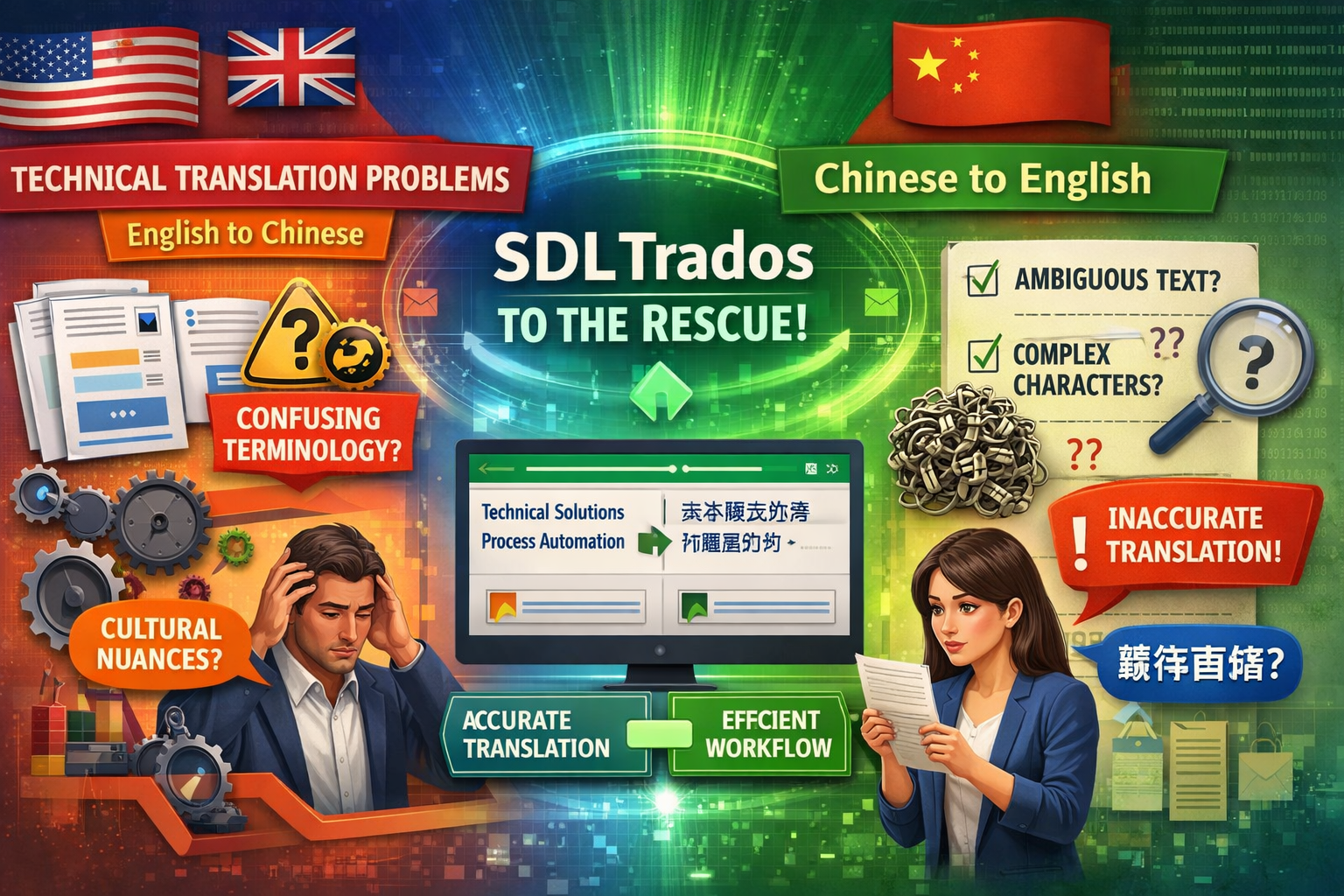
The translation corridor between English and Chinese represents one of the most challenging yet crucial pathways in global communication. As the world's most spoken language and the international language of business and technology respectively, Chinese and English connect billions of people and facilitate trillions of dollars in commerce. Yet these languages could hardly be more different in structure, writing system, and cultural context. For technical translators working between English and Chinese, these differences create unique challenges that demand sophisticated tools and strategies. This is where computer-assisted translation (CAT) tools like SDL Trados Studio, combined with well-maintained translation memories and termbases, become not just helpful but essential.
The Fundamental Challenge: Two Radically Different Systems
Before exploring solutions, we must understand the problems. English and Chinese differ at every linguistic level, creating obstacles that simple dictionary lookups cannot overcome.
Writing Systems and Character Encoding
The most obvious difference lies in writing systems. English uses a 26-letter alphabet where characters represent sounds, while Chinese employs thousands of logographic characters where each symbol represents meaning. This fundamental distinction creates immediate technical challenges. Chinese text requires specific character encoding (UTF-8 or GB18030), and display issues can corrupt characters if systems aren't properly configured. Technical documents must preserve character integrity through multiple file format conversions—a process where errors can silently introduce incorrect characters that change meaning entirely.
Grammatical Structure
English and Chinese organize information differently. English relies heavily on grammatical markers like verb tenses, articles, and plural forms. Chinese lacks these features, instead using context, aspect markers, and measure words to convey similar information. English sentences typically follow Subject-Verb-Object order with clear syntactic relationships marked by word endings and function words. Chinese allows more flexible word order and relies on position and context for grammatical relationships.
For technical translation, these differences mean that translating from English to Chinese requires condensing information that's explicitly marked in English into more compact Chinese expressions, while translating from Chinese to English requires expanding implicit information into explicit grammatical forms.
Technical Terminology
Technical terminology presents particular challenges. Many technical terms in English derive from Latin or Greek roots and carry meaning through their etymology. Chinese technical terms are often newly coined combinations of existing characters, each contributing semantic elements to the compound meaning. A single English technical term might require a multi-character Chinese equivalent, while a concise Chinese compound might need several English words to convey fully.
Consider "software"—in Chinese, this becomes 软件 (ruǎnjiàn), literally "soft-piece," a calque that mirrors the English metaphor. However, more complex terms like "cloud computing" (云计算, yún jìsuàn) or "blockchain" (区块链, qū kuài liàn) show how Chinese creates technical vocabulary through semantic composition rather than borrowing.
Cultural and Conceptual Differences
Technical translation isn't purely linguistic. Chinese and Western technical documentation follow different conventions. Chinese technical writing tends toward more formal, classical expressions, while English technical writing prioritizes clarity and directness. Chinese users expect different information hierarchy and may prefer certain organizational patterns. These cultural preferences affect how technical content should be structured and expressed in each language.
SDL Trados Studio: A Powerful Ally
SDL Trados Studio has become the industry standard CAT tool for good reasons, and its features prove particularly valuable for English-Chinese technical translation. The software addresses many of the challenges inherent in this language pair through sophisticated features designed for complex translation workflows.
Handling Character Encoding
Trados Studio manages Chinese character encoding seamlessly, preserving character integrity through file format conversions. When translating technical documentation that passes through multiple formats—from Word to XML to InDesign and back—Trados maintains proper UTF-8 encoding, preventing the character corruption that can occur with simpler tools. This reliability is crucial when a single corrupted character can change technical specifications or safety warnings.
Segmentation and Alignment
Trados' segmentation engine recognizes both English and Chinese sentence boundaries, a non-trivial task given that Chinese doesn't always use clear sentence-ending punctuation like English. Proper segmentation ensures that translation memory matches and suggestions appear at appropriate granularity—neither too small to provide context nor too large to be reusable.
Quality Assurance for Chinese
The software's QA features check for common English-Chinese translation errors: number discrepancies (ensuring measurements and specifications match), terminology consistency (crucial for technical accuracy), tag placement (maintaining document formatting), and character encoding issues (catching corruption before delivery).
Translation Memories: Building Institutional Knowledge
Translation memories (TMs) are databases that store previously translated segments alongside their source text. For English-Chinese technical translation, TMs provide extraordinary value that compounds over time.
Consistency Across Projects
Technical documentation demands absolute consistency. If a user manual translates "power supply unit" as 电源装置 (diànyuán zhuāngzhì) in one chapter, the same term must appear identically throughout all documentation. TMs ensure this consistency automatically, suggesting previous translations whenever the same or similar segments appear.
For Chinese translation, consistency extends beyond terminology to grammatical patterns and expression styles. TMs preserve not just what terms were used but how entire technical concepts were expressed, maintaining a uniform voice across documentation sets.
Leveraging Previous Work
Technical documentation for product lines shares substantial content. User manuals, specifications, and safety warnings often contain identical or nearly identical segments across product variants. A well-populated TM allows translators to leverage previous work, achieving high match rates that dramatically reduce translation time and cost.
Consider a company producing industrial equipment. Their English manuals might share 60-70% content across models. With robust TMs, translators might find exact or fuzzy matches for most segments, requiring fresh translation only for model-specific features and updated specifications. This efficiency is particularly valuable for Chinese translation, which requires more time per word than many European languages due to character complexity and research requirements.
Evolution and Refinement
TMs aren't static. As terminology evolves, technical understanding improves, and translation quality standards rise, TMs can be updated and refined. Segments can be edited to reflect preferred translations, ensuring that future projects benefit from improved translations. This creates a virtuous cycle where translation quality and efficiency improve over time.
For English-Chinese translation, this evolutionary aspect proves crucial. Technical Chinese evolves rapidly as new technologies emerge and terminology standardizes. TMs can be updated to reflect current preferred terms, ensuring that older translations don't perpetuate outdated terminology.
Termbases: Mastering Technical Vocabulary
While translation memories work at the sentence or segment level, termbases (TBs) manage terminology—the specialized vocabulary that defines technical fields. For English-Chinese technical translation, well-maintained termbases are indispensable.
Terminology Consistency
Technical terms must be translated consistently throughout all documentation. Termbases ensure that complex English technical terms like "heat exchanger," "servo motor," or "microcontroller" always receive the same Chinese translation: 热交换器 (rè jiāohuàn qì), 伺服电机 (sìfú diànjī), 微控制器 (wēi kòngzhì qì). This consistency isn't just aesthetic—it's essential for user comprehension and safety.
Context and Usage Notes
Termbases can store more than simple term pairs. They can include definitions, usage notes, forbidden terms, and context information. For English-Chinese translation, this additional information proves invaluable. A term might have multiple possible Chinese translations depending on context, industry, or regional preference. Termbases can specify which translation to use when, preventing errors and reducing translator decision fatigue.
For example, "processor" might be translated as 处理器 (chǔlǐ qì) in computer contexts but 加工机 (jiāgōng jī) in manufacturing contexts. Termbases can distinguish these uses, ensuring appropriate translation selection.
Client-Specific Terminology
Different clients often prefer different Chinese terms for the same English concept, particularly for newer technologies where terminology hasn't fully standardized. Termbases allow translators to maintain client-specific terminology preferences, ensuring that each client's documentation uses their preferred terms consistently.
Simplified vs. Traditional Chinese
Chinese exists in two main writing systems: Simplified (used in mainland China, Singapore) and Traditional (used in Taiwan, Hong Kong, Macau). Technical terms sometimes differ between these systems beyond mere character differences. Termbases can manage both variants, ensuring that documentation for different markets uses regionally appropriate terminology.
Practical Workflows: Putting It All Together
Successful English-Chinese technical translation using SDL Trados combines TMs and TBs in efficient workflows that maximize quality while minimizing time and cost.
Project Preparation
Before translating, experienced technical translators prepare thoroughly. They ensure that relevant TMs are attached to the project, providing access to previous translations. They verify that appropriate termbases are active, ensuring terminology suggestions appear during translation. They review project specifications, understanding the target market (mainland China, Taiwan, Singapore) and any client-specific terminology preferences.
Translation Process
During translation, Trados presents source segments alongside TM matches and terminology suggestions. Translators see how similar English segments were previously translated into Chinese, providing consistency and inspiration. Terminology windows highlight technical terms in the source text and suggest approved Chinese translations from the termbase.
This integrated workflow reduces cognitive load. Instead of manually searching for previous translations or looking up terms in separate dictionaries, translators access this information within their working environment, maintaining focus and efficiency.
Quality Assurance
After translation, Trados' QA tools check for common errors specific to English-Chinese translation. They verify that numbers match between English and Chinese (crucial for technical specifications), that formatting tags are properly placed, that no segments were missed, and that terminology was applied consistently.
Continuous Improvement
After project delivery, successful teams engage in continuous improvement. They update TMs with corrected translations, add new terms to termbases based on project research, and refine existing terminology based on client feedback or industry developments.
Converting SDL Files: Bridging Translation and Business Systems
While SDL Trados excels at the translation process, business workflows often require translation data in different formats. Marketing departments might need bilingual content in Excel for review, project managers might want Word documents for non-technical stakeholders, and clients increasingly request deliverables in formats other than Trados' native files.
This is where specialized conversion services become valuable. Platforms like linigu.cloud address this need by converting various SDL file formats into bilingual Excel or Word files, making translation data accessible to broader teams.
Why Conversion Matters
SDL Trados stores translations in proprietary formats optimized for translation workflows but not necessarily for other business purposes. Converting these files into Excel allows data analysis, term extraction, and review by team members who don't use Trados. Bilingual Word documents enable stakeholders to review translations with source and target text side by side, facilitating quality assessment and approval processes.
For English-Chinese translation specifically, bilingual formats prove particularly valuable. Reviewers who are native Chinese speakers but may not be professional translators can review Chinese translations alongside English source text, identifying technical errors or awkward phrasing even without CAT tool expertise.
Use Cases
Translation agencies convert SDL files to Excel for client delivery, providing accessible bilingual glossaries or translation reviews. Corporate translation departments convert files to Word for subject matter expert review, enabling engineers or product managers to verify technical accuracy. Terminology teams extract bilingual term lists from SDL projects for terminology database management.
Workflow Integration
Services like linigu.cloud integrate into existing workflows, accepting SDL bilingual files, translation memories, or other Trados formats and outputting clean, formatted Excel or Word documents. This bridges the gap between specialized translation tools and general business software, ensuring that valuable translation data remains accessible and useful beyond the translation department.
Best Practices for English-Chinese Technical Translation with Trados
Success in English-Chinese technical translation requires more than just tools—it demands systematic approaches and professional discipline.
Build and Maintain Quality TMs
Invest time in creating well-structured translation memories. Ensure that English source text is well-written and consistent before translation, as TMs perpetuate both good and poor source content. Regularly clean TMs, removing duplicate segments and correcting errors. For Chinese translation, consider maintaining separate TMs for Simplified and Traditional Chinese to prevent cross-contamination.
Develop Comprehensive Termbases
Create detailed termbases that capture not just term pairs but context, usage notes, and client preferences. Involve subject matter experts in termbase development, ensuring technical accuracy. For Chinese terminology, research industry standards and regional preferences, documenting this information in termbase notes.
Standardize Workflows
Establish clear workflows for project handling, quality assurance, and TM maintenance. Ensure all team members follow consistent processes, maximizing the benefits of shared TMs and TBs. Document decisions about terminology, style, and formatting so that knowledge isn't lost as team composition changes.
Continuous Learning
Technical fields evolve, and so does language. Stay current with developments in both technical domains and Chinese terminology. Attend industry conferences, participate in translator forums, and engage with technical communities to ensure that translations reflect current best practices and terminology.
Leverage Technology Thoughtfully
While SDL Trados is powerful, it's a tool, not a replacement for expertise. Use TM suggestions thoughtfully, recognizing that context may require different translations even for similar segments. Verify terminology suggestions against current usage and context. Machine translation can provide rough drafts for some content, but Chinese technical translation typically requires substantial human expertise.
The Future of English-Chinese Technical Translation
English-Chinese technical translation will only grow more important as China continues its technological development and global economic integration. The challenges inherent in this language pair ensure that sophisticated tools like SDL Trados, supported by well-maintained TMs and TBs, will remain essential for professional-quality work.
Emerging technologies like neural machine translation may handle simpler content, but complex technical translation between English and Chinese will continue requiring human expertise augmented by professional CAT tools. The combination of linguistic knowledge, technical understanding, cultural competence, and tool mastery defines the successful English-Chinese technical translator.
Conclusion
Technical translation between English and Chinese presents formidable challenges stemming from fundamental linguistic, cultural, and writing system differences. SDL Trados Studio, particularly when leveraged with robust translation memories and comprehensive termbases, provides powerful solutions to these challenges. The software manages character encoding complexity, ensures terminology consistency, preserves formatting integrity, and enables translators to build on previous work efficiently.
Success requires more than just tools, however. It demands systematic workflows, continuous learning, disciplined TM and TB maintenance, and professional expertise that understands both languages deeply. When these elements combine, the result is technical translation that bridges East and West effectively, enabling global commerce, knowledge transfer, and technological collaboration.
For teams and organizations working with English-Chinese technical content, investing in proper CAT tools, building quality translation assets, and establishing professional workflows pays dividends in consistency, efficiency, and quality. And when those translation assets need to be accessible beyond the CAT tool environment, conversion services like those offered by linigu.cloud ensure that valuable bilingual content can flow seamlessly into broader business workflows, maximizing the value of translation investments.
The bridge between English and Chinese technical communication stands strong when built on solid linguistic expertise, professional tools, and systematic approaches—connecting two of the world's most important languages and the vast communities they represent.
Comments ()
No comments yet. Be the first to comment!